In the competitive world of higher education, staying updated is key. One such update that aspiring graduate students must be aware of is the changes in the NEW GRE (Graduate Record Examination). Starting from September 22, 2023, the GRE is undergoing some significant changes. These changes are designed to enhance the test-taking experience and ensure that the exam continues to be a reliable measure of students’ readiness for graduate-level study.
The GRE General Test is a prominent tool used by universities worldwide. It evaluates candidates on verbal reasoning, quantitative reasoning, and analytical writing skills. This score is vital for applications to many graduate and business school programs. Understanding the new GRE format is essential for effective preparation. Not only does this knowledge help in planning your study schedule, but it also enables you to utilize the right resources.
This blog will serve as your guide. We’ll break down what’s changing, what’s staying the same, and give an overview of the test. Plus, we’ll cover the complete syllabus and recommend the best preparation resources. So, if you’re ready to take the next step in your academic journey, let’s dive in and explore the new GRE together!
Why GRE is important.
GRE is a standardized test that is used by many graduate schools to assess applicants' readiness for graduate-level study. The GRE measures verbal reasoning, quantitative reasoning, and analytical writing skills.
The GRE is important for a few reasons:
- It provides a common measure of academic ability that can be used to compare applicants from different backgrounds.
- It can help admissions committees to identify applicants who are likely to be successful in graduate school.
- It can be used to award scholarships or financial aid to qualified applicants.
- It can help applicants to prepare for the rigors of graduate school.
Not all graduate schools require the GRE, but many do. If you are planning to apply to graduate school, it is important to research the specific requirements of the programs you are interested in.
Here are some of the benefits of taking the GRE:
- The GRE can help you to assess your strengths and weaknesses in the areas of verbal reasoning, quantitative reasoning, and analytical writing.
- The GRE can give you a head start on your graduate school applications.
- The GRE can help you to be more competitive for scholarships and financial aid.
- The GRE can help you to prepare for the rigors of graduate school.
If you are considering taking the GRE, there are a few things you can do to prepare:
- Take a practice test to get a feel for the format of the exam.
- Study the material that is covered on the GRE.
- Practice your writing skills.
- Get a good night's sleep on the night before the exam.
Taking the GRE can be a daunting task, but it is also an important step in the process of applying to graduate school. By following these tips, you can increase your chances of success on the GRE and on your graduate school applications.
 What is Changing in GRE?
Several changes are set to be implemented to the GRE (Graduate Record Examination) effective from September 22, 2023.
What is Changing in GRE?
Several changes are set to be implemented to the GRE (Graduate Record Examination) effective from September 22, 2023.
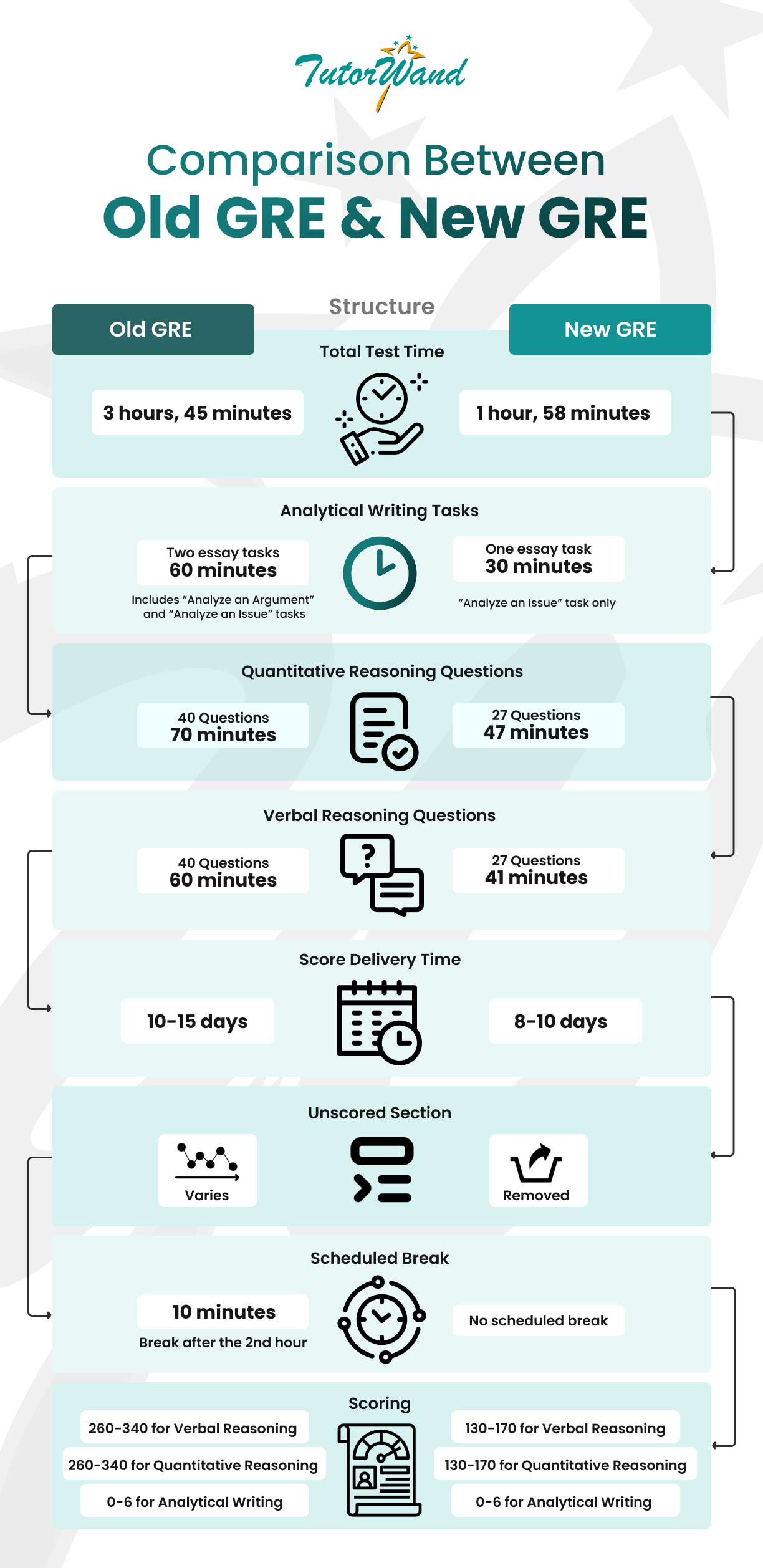
- Reduced Testing Time: The overall duration of the GRE General Test will be cut by half, shortened from 3 hours 45 minutes to 1 hour 58 minutes. This change is aimed at reducing test fatigue and improving focus for test-takers.
- Removal of "Analyze an Argument" Task: The Analytical Writing section will now only include the "Analyze an Issue" task. The "Analyze an Argument" task will be eliminated. This means the Analytical Writing section will only require you to write one essay instead of two.
- Reduced Number of Questions: The Quantitative Reasoning and Verbal Reasoning sections will have fewer questions. The number of questions will be decreased from 40 to 27.
- Removal of the Unscored Section: Currently, the GRE includes an unscored section that is used for ETS research. This section, which does not count toward the test-taker’s score, will be removed in the shorter GRE.
- No Scheduled Breaks: Since the test duration will now be under 1 hour 58 minutes, the scheduled breaks have been removed.
- Faster Score Reporting: The amount of time it takes to receive your score after completing the exam will be reduced to between eight and 10 days, which is faster than the current timeline of 10 to 15 days.
What is remaining the same in GRE?
- Question Types and Measured Skills: All other GRE General Test question types will remain the same. Therefore, all existing prep materials are still valid and can be used to help prepare for test day.
- Registration Process: To register, test-takers will follow the normal registration process outlined in the GRE Information Bulletin.
- Test Fee: The price of taking the test will remain the same at $220.
GRE Test Overview
Here's what to expect once tests start on September 22, 2023.
| Section |
Structure |
Estimated Timing |
| Analytical Writing |
1 section, 1 essay task |
30 minutes |
| Quantitative Reasoning |
2 sections, 27 questions total |
47 minutes |
| Verbal Reasoning |
2 sections, 27 questions total |
41 minutes |
| Total Time |
5 Sections, 55 questions |
1 hour, 58 minutes |
GRE Syllabus
The GRE (Graduate Record Examination) is divided into three primary sections: Verbal Reasoning, Quantitative Reasoning, and Analytical Writing. Here's a brief breakdown of what each section covers:
Verbal Reasoning:
This section tests your ability to understand, interpret, and analyze various types of written material, as well as your ability to recognize relationships among words and concepts. The Verbal Reasoning section is divided into three types of questions:
- Reading Comprehension: These questions measure your ability to understand, interpret, and analyze reading passages.
- Text Completion: These questions involve filling in blanks in sentences or short passages to complete the idea being expressed.
- Sentence Equivalence: These questions require you to complete a sentence by choosing words that are similar in meaning.
Quantitative Reasoning:
This section assesses your basic mathematical skills, understanding of mathematical concepts, and ability to reason quantitatively and solve problems in a quantitative setting. The Quantitative Reasoning section covers four types of questions:
- Quantitative Comparison: These questions ask you to compare two quantities and determine which is greater.
- Problem-Solving: These questions require you to solve problems using basic mathematical concepts.
- Data Interpretation: These questions present you with data in the form of graphs, tables, or other displays, and ask you to interpret or analyze that data.
- Numeric Entry: You'll need to provide your answer as an integer, decimal, or fraction.
Analytical Writing:
This section tests your ability to articulate complex ideas clearly and effectively, support ideas with relevant reasons and examples, examine claims and accompanying evidence, sustain a well-focused, coherent discussion, and control the elements of standard written English. The Analytical Writing section consists of two separately timed writing tasks:
- Analyze an Issue: You'll be presented with an opinion on an issue of general interest and asked to address the specific instructions, develop a position, and support your views with reasons and examples drawn from your own experiences, observations, or readings.
Remember, the GRE requires not only content knowledge but also testing strategies and time management skills. It's a good idea to familiarize yourself with the format of the test and practice with sample questions or full-length practice tests.
Best Resources to Prepare for GRE
There are many resources available to help you prepare for the GRE (Graduate Record Examination). Here are some of the top choices:
Official ETS (Educational Testing Service) Resources: ETS provides free and paid GRE study materials, including the Official Guide with authentic questions and test advice. They also offer computer-adaptive Power-prep practice tests, giving a realistic experience of the GRE.
Manhattan Prep GRE: Manhattan Prep offers a comprehensive suite of GRE prep courses, books, and free resources. Their study materials are highly regarded and provide in-depth coverage of both the Verbal and Quantitative sections of the GRE.
Magoosh: Magoosh provides a variety of GRE prep options, from self-study resources to guided study plans. Their online platform includes video lessons, practice questions with video explanations, full-length practice tests, and study schedules. They also offer a mobile app for studying on-the-go.
Kaplan Test Prep: Kaplan offers a comprehensive range of GRE prep resources, including live online classes, self-paced courses, private tutoring, practice tests, and books. Their resources are quite exhaustive and cover a wide range of difficulty levels.
Princeton Review: Princeton Review offers various GRE prep options, including self-paced courses, classroom courses, and private tutoring. Their study materials include practice tests, instructional videos, and drills.
Remember, the best resource for you will depend on your own learning style, strengths and weaknesses, and study schedule. Most importantly, be consistent with your preparation, practice regularly, and assess your progress periodically to identify areas for improvement.
Conclusion
The GRE exam can be difficult, but with proper preparation and a solid understanding of the test format and content, you can confidently approach it. You'll be well-equipped to obtain your goal score and uncover great options for your academic and professional future if you follow the suggestions and techniques suggested in this guide.
Remember that success in the GRE requires more than simply intrinsic brilliance; it also requires dedication, effort, and excellent study habits. So, begin your GRE preparation today and let your dreams soar!

 by TutorWand